
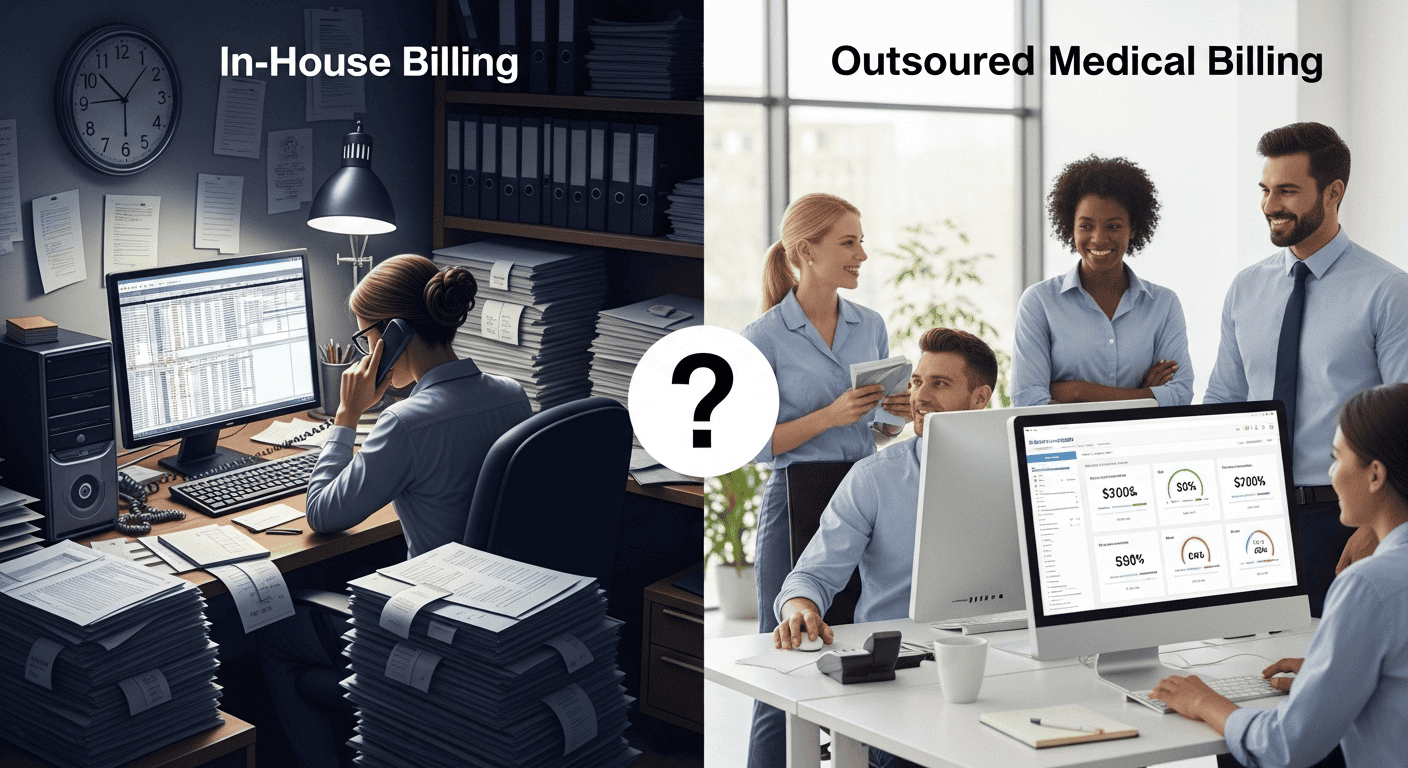
Most healthcare practices don’t think about billing until something goes wrong, payments slow down, denials increase, or staff feel stretched thin. At that point, a common question surfaces: Should we keep billing in-house, or is it time to outsource?
The debate around outsourced medical billing vs. in-house billing isn’t about which option is universally better. It’s about which approach fits your practice’s size, complexity, staffing realities, and long-term goals. Both models can work well. Both can also create problems if they’re not managed thoughtfully.
This article breaks down how each option works, what practices are often overlooked, and how to evaluate which billing model makes the most sense for your situation without hype or pressure.
What In-House Medical Billing Really Involves
In-house medical billing means your practice employs staff who handle billing tasks internally. This typically includes:
- Charge entry and coding
- Claims submission
- Payment posting and reconciliation
- Denial follow-up
- Patient billing and collections
Where In-House Billing Works Well
In-house billing can be a good fit when:
- Claim volume is manageable
- Staff turnover is low
- Billing rules are relatively stable
- Leadership has time to oversee billing performance
Practices with consistent workflows and experienced billing staff often value the direct control that in-house billing provides.
Common Challenges with In-House Medical Billing
Despite its advantages, in-house billing comes with ongoing responsibilities that are easy to underestimate.
Staffing and training:
Billing staff require continuous training as codes, payer rules, and compliance standards change. When a key employee leaves, knowledge gaps can appear quickly.
Oversight and accountability:
Practice leaders must monitor aging reports, denial trends, and payer performance. Without consistent oversight, small issues can quietly grow.
Limited specialization:
Most in-house teams handle a wide range of tasks. They may not have deep expertise in every payer or specialty nuance, especially in complex areas like behavioral health or multi-payer environments.
What Outsourced Medical Billing Looks Like in Practice
Outsourced billing means partnering with a third-party company that manages billing functions on your behalf. These services may include:
- Claims submission and follow-up
- Denial management
- Payment posting
- Reporting and analytics
- Compliance monitoring
Some practices outsource everything; others use outsourced billing services to support specific areas like denial management or backlog cleanup.
Why Practices Consider Outsourcing Medical Billing
Practices often explore outsourcing medical billing when internal systems start to strain.
Common reasons include:
- Rising claim denials
- Difficulty hiring or retaining billing staff
- Increasing payer complexity
- Practice growth or expansion
- Desire for more predictable cash flow
The goal is usually operational stability, not convenience.
Medical Billing Outsourcing Benefits and Limitations
Outsourcing offers real advantages, but it’s not without trade-offs.
Potential benefits:
- Access to specialized billing expertise
- Consistent follow-up on unpaid claims
- Reduced dependency on individual staff members
- More time for leadership to focus on operations and care
These are often cited as key benefits of outsourcing medical billing, especially for practices dealing with complex payer requirements.
Potential limitations:
- Less day-to-day control
- Need for clear communication and reporting
- Onboarding time to align workflows
- Dependence on the quality of the billing partner
Outsourcing works best when expectations, processes, and accountability are clearly defined.
Comparing Outsourced vs In-House Billing Across Key Areas
Rather than framing this as a competition, it’s more helpful to compare how each model performs in areas that matter most to practices.
Cost Structure
In-house billing involves fixed costs:
- Salaries and benefits
- Training and continuing education
- Software and systems
- Coverage during absences
Outsourced billing typically uses a variable cost model tied to collections or claim volume. This can feel more predictable, but only if performance is consistent.
Expertise and Adaptability
Billing rules change frequently. Outsourced teams often specialize in staying current with payer policies across multiple clients. In-house teams may need more time and resources to keep up, especially if billing is just one of many responsibilities.
Scalability
Growth can strain in-house systems quickly. Adding providers, locations, or services often means hiring and training additional staff.
Outsourced models tend to scale more smoothly, adjusting resources as volume changes.
Communication and Visibility
In-house billing offers immediate access to staff, which some practices value highly.
Outsourcing requires structured communication, clear reports, defined points of contact, and regular check-ins to maintain visibility and trust.
Common Misconceptions About Outsourcing Billing
One misconception is that outsourcing means “giving up control.” In reality, control depends on reporting, transparency, and partnership, not location.
Another misunderstanding is that outsourcing automatically fixes billing problems. Like any system, outsourced billing requires oversight, accurate documentation, and collaboration with clinical teams.
Finally, some practices assume outsourcing is only for large organizations. In reality, small and mid-sized practices often benefit the most when resources are limited.
Practical Insights: How to Decide What’s Right for Your Practice


There’s no universal answer, but asking the right questions helps clarify the decision.
Ask About Your Current Pain Points
- Are denials increasing?
- Is cash flow unpredictable?
- Is the staff overwhelmed?
Evaluate Internal Capacity
- Do you have time to oversee billing performance?
- Is your billing team adequately trained and supported?
Consider Long-Term Goals
- Are you planning to grow or add services?
- Do you need flexibility as payer rules change?
Some practices choose a hybrid approach, keeping core billing in-house while outsourcing complex or time-consuming tasks.
An Expert Perspective: Why Billing Experience Matters More Than the Model
Whether billing is handled internally or externally, experience matters. The most effective billing systems anticipate problems rather than react to them.
Experienced billing professionals:
- Recognize denial patterns early
- Understand payer behavior
- Know how documentation affects reimbursement
- Adapt workflows as rules change
The real risk isn’t choosing the “wrong” model; it’s choosing a model without the expertise to manage it well.
Conclusion:
The question isn’t whether outsourced billing or in-house billing is better in general. It’s the approach that aligns with your practice’s needs, resources, and goals right now.
Some practices thrive with strong internal teams. Others find stability and clarity through outsourcing. Many evolve.
Taking a clear-eyed look at your billing performance and being open to change when needed can help protect revenue and reduce administrative stress. If questions remain, learning more about different billing models can be a helpful next step
Schedule a consultation to review your billing model and identify opportunities for improvement.
FAQs
- Is outsourced medical billing more expensive than in-house billing?
It depends on claim volume, staff costs, and efficiency. Outsourcing often replaces fixed costs with variable ones. - Can a practice combine in-house and outsourced billing?
Yes. Many practices use a hybrid approach to manage complexity and workload. - Does outsourcing billing reduce denials automatically?
Not automatically. It helps when combined with good documentation, communication, and oversight. - What should practices look for in a billing partner?
Experience, transparency, clear reporting, and responsiveness matter more than promises. - When is it time to reconsider in-house billing?
When denials rise, staff turnover increases, or billing oversight becomes unmanageable.